
If you’re researching live streaming server cost, the number you actually need isn’t just the monthly server fee. A two-hour livestream with 50 viewers has a completely different cost profile from the same event watched by 5,000 people.
The good news is that you can estimate it fairly quickly once you know your stream duration, video quality, and audience size.
1. Live Streaming Server Cost Starts With Viewers and Watch Time
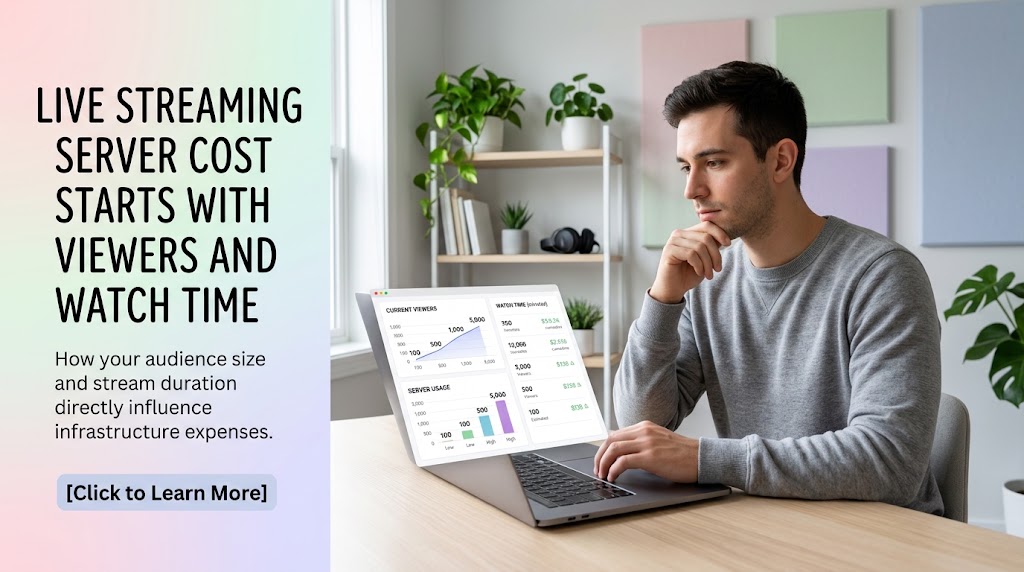
The biggest mistake is calculating livestream expenses like ordinary web hosting. A website might use relatively little bandwidth, while live video continuously moves data from your encoder to viewers.
A Simple Two-Hour Cost Example
Let’s assume a 2-hour livestream where everyone watches the entire broadcast.
The total viewing time becomes:
- 100 viewers × 120 minutes = 12,000 viewer-minutes
- 500 viewers × 120 minutes = 60,000 viewer-minutes
- 1,000 viewers × 120 minutes = 120,000 viewer-minutes
- 5,000 viewers × 120 minutes = 600,000 viewer-minutes
That’s the number that starts making a difference on usage-based platforms.
For example, Cloudflare Stream currently charges $1 per 1,000 minutes delivered. Under that model, 12,000 viewer-minutes would represent about $12, while 120,000 viewer-minutes would be about $120, before considering other applicable costs.
How Much Does a Live Stream Cost for 100 Viewers?
Using the same two-hour example, 100 viewers generate 12,000 delivered minutes.
At $1 per 1,000 delivered minutes, that’s approximately $12 for delivery on Cloudflare Stream.
For a small webinar or community event, that can be a reasonable starting point.
But remember, this is a usage calculation, not a universal livestream price. Other providers use different billing structures.
What Happens at 1,000 Viewers?
At 1,000 viewers watching for two hours, you’re already at 120,000 viewer-minutes.
At the same $1 per 1,000-minute rate, that’s roughly $120 in delivery.
And that’s precisely why audience size matters more than the server’s advertised monthly price.
If viewers watch only half of the event, the delivery minutes are roughly cut in half too.
Bandwidth Is the Hidden Number
At a 4 Mbps video bitrate, one continuous viewer consumes roughly 1.8 GB per hour before accounting for protocol and delivery overhead.
That means 1,000 viewers watching for two hours could represent roughly 3.6 TB of raw video data.
This is why a cheap VPS can become surprisingly expensive once a stream goes viral.
2. Server Cost for Live Streaming Depends on Your Setup
There are two broad approaches: managed streaming platforms or your own infrastructure.
A Managed Platform Gives You Predictable Building Blocks
Cloudflare Stream currently charges $5 per 1,000 minutes stored and $1 per 1,000 minutes delivered. Encoding and ingress are included in the pricing model.
So if you broadcast for 120 minutes and record the event, storage itself can be relatively small compared with viewer delivery.
Mux uses a different model. Live input starts at $0.025 per minute, while delivery starts at $0.0008 per minute for the relevant quality tier. Mux also provides the first 100,000 delivered minutes each month free under its current pricing structure.
A 120-minute stream therefore has an input cost starting around:
120 × $0.025 = $3
The final bill depends on resolution, delivery, storage, and other usage.
What About a VPS?
A VPS can start at only a few dollars per month, but that isn’t the complete server cost for live streaming.
You may still need:
- transcoding resources
- additional bandwidth
- object storage
- CDN
- monitoring
- backups
- security
- technical maintenance
For example, a $10 VPS isn’t automatically a $10 livestream. If it can’t handle the encoder workload or viewer traffic, you’ll need additional infrastructure.
A Practical Budget
For a small independent stream, I’d roughly think in these ranges:
- $5–$20/month: experimentation and very small audiences
- $20–$50/month: small creator or regular broadcast
- $50–$200/month: growing audience and heavier usage
- $200+/month: larger events, significant delivery, or custom infrastructure
These aren’t universal provider prices. They’re practical budget ranges to help you decide how seriously you need to engineer the setup.
If you’re building your first setup, this beginner hosting playbook for going live is useful before committing to a more expensive infrastructure.
3. Live Stream Price Comparison With Real Numbers
Now we can put the providers into perspective.
Cloudflare Stream
Cloudflare’s pricing is unusually straightforward:
- $5 / 1,000 minutes stored
- $1 / 1,000 minutes delivered
- encoding included
- ingress included
So 100 viewers watching a 2-hour event means approximately $12 in delivery.
At 1,000 viewers, approximately $120.
That’s a useful mental benchmark when estimating live stream price.
Mux
Mux starts live input at $0.025/minute and delivery at $0.0008/minute, with pricing varying according to video quality and usage.
A 2-hour broadcast therefore starts around $3 in live input.
Delivery then depends on how many minutes your audience consumes.
Mux is particularly attractive if you’re developing a website or application rather than simply wanting a basic broadcast page.
Castr
Castr takes a subscription approach rather than making every part of the calculation feel like a spreadsheet.
Its Starter plan is currently listed at $19.99/month, with higher plans increasing bandwidth, streams, and other limits.
That can be easier for creators who prefer knowing their basic monthly commitment upfront.
Amazon IVS
Amazon IVS uses separate input and output charges. Its pricing depends on the channel type, resolution, and viewing volume.
This makes it powerful for applications that already use AWS, but less beginner-friendly if you’re simply trying to calculate tomorrow’s webinar budget.
So Which Number Should You Use?
For a quick planning estimate:
Small stream: budget around $10–$30/month.
Regular stream with hundreds of viewers: think roughly $30–$150/month.
Large events: calculate viewer-minutes first. Costs can reach hundreds of dollars or more depending on quality and platform.
The important thing is that the final bill follows usage. A platform costing $20 per month can become more expensive than expected if its bandwidth or viewer limits are exceeded.
4. Final Verdict on Live Streaming Server Pricing
The cheapest live streaming server cost isn’t necessarily the lowest total cost.
For 100 people watching a two-hour stream, you’re dealing with around 12,000 viewer-minutes. At 1,000 viewers, that’s 120,000 minutes. At 5,000 viewers, it becomes 600,000 minutes.
That is the number to keep in your head.
For beginners, I’d start with a managed service. Cloudflare Stream is attractive when predictable minute-based billing matters. Mux is excellent for developers and custom platforms. Castr makes sense for creators who prefer subscription-style broadcast tools.
If you’re expecting thousands of viewers, don’t guess. Calculate the delivery workload first.
A $10 server may look cheap on paper. A failed 5,000-viewer broadcast? Not so cheap.
Q&A
How much does a 2-hour livestream cost for 100 viewers?
At Cloudflare Stream’s current $1 per 1,000 delivered minutes, 100 viewers watching all 120 minutes equals 12,000 minutes, or about $12 in delivery.
How much does a 2-hour livestream cost for 1,000 viewers?
The same calculation produces 120,000 delivered minutes. At $1 per 1,000 minutes, that’s approximately $120 in delivery on Cloudflare Stream.
Is a $10 VPS enough for livestreaming?
It can be enough for testing or a small controlled stream, but there’s no guarantee. Transcoding, bandwidth, CDN delivery, storage, and viewer count can push the actual infrastructure requirement far beyond the VPS rental.

Seo Ji-an worked as a junior broadcast producer before moving into livestream production for beauty brands, independent creators, and online retailers.
During her seven years in digital production, she has handled studio preparation, lighting checks, audio testing, run sheets, and backup streaming systems.
She writes practical guides for beginners who want to prepare a reliable broadcast without turning a small room into an expensive television studio.